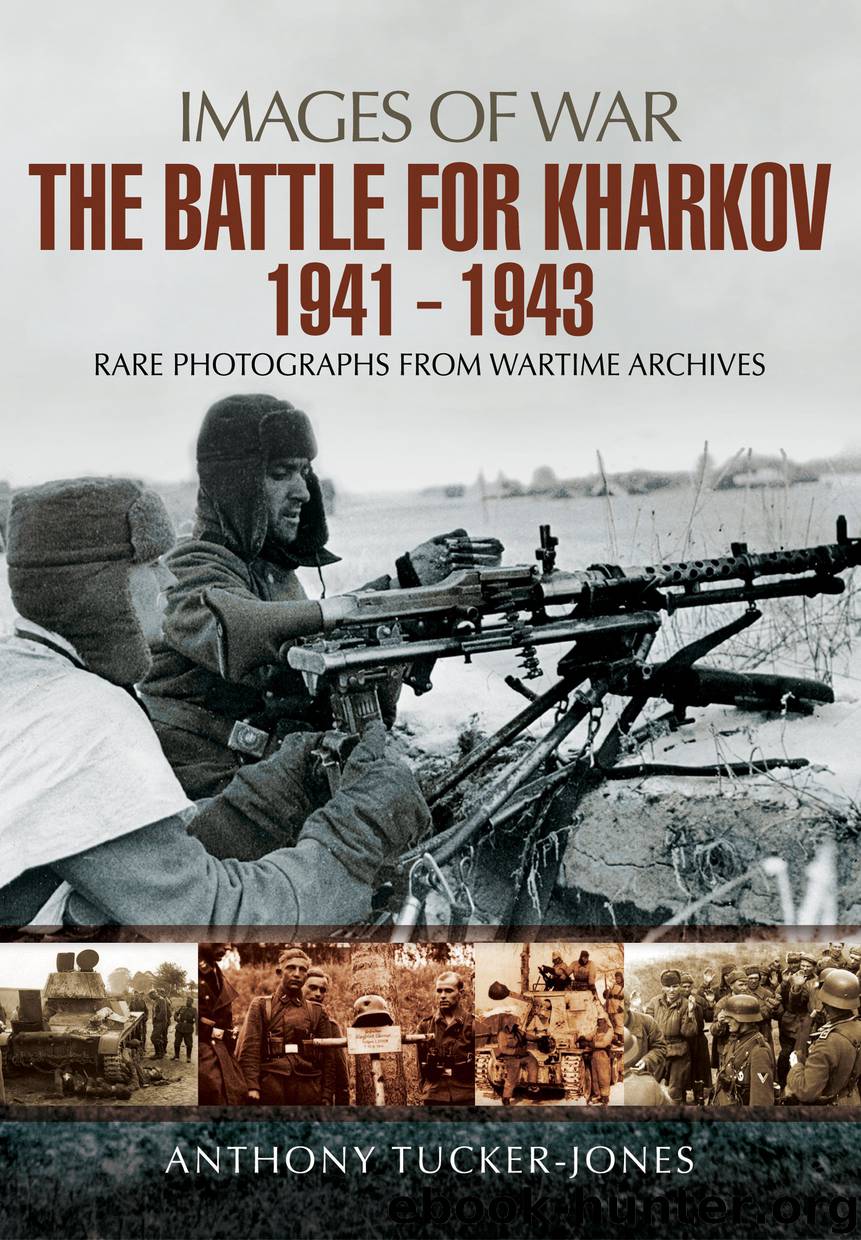
The Battle for Kharkov 1941 - 1943: Rare Photographs from Wartime Archives by Anthony Tucker-Jones
Author:Anthony Tucker-Jones
Language: eng
Format: epub
Tags: HISTORY / Military / World War II
Publisher: Pen and Sword
Published: 2016-06-30T04:00:00+00:00
In early 1942 the Germans began to conduct a deception plan, codenamed Kremlin, which was designed to convince Stalin that the German summer offensive would be directed towards finally capturing Moscow. ‘Information’ was leaked to foreign newspapers, while Army Group Centre conducted poorly concealed preparations which seemed to indicate that Hitler would again attack the Soviet capital in force.
In the meantime, during the spring of 1942 the Germans began preparing for their real summer offensive, a massive southern assault known as Operation Blue. Their first moves were to secure their flanks. Way to the south, this meant driving the Red Army completely from the Crimea and capturing Sevastopol. This would both protect the right flank of Field Marshal Fedor von Bock’s Army Group South and enable General Erich von Manstein’s 11th Army to cross the Straits of Kerch in support of the 1st Panzer Army and the 17th Army’s offensive along the eastern coast of the Black Sea once they were across the lower Don and Donets.
Manstein moved to eliminate the Red Army from the Kerch peninsula on 8 May 1942 with Operation Bustard Trap. He diverted all his forces except for his 54th Corps and the Romanian Army, which remained before Sevastopol. In total, six German and three Romanian divisions were thrown at the Soviet 44th, 47th and 51st Armies. The Germans, with Luftwaffe support, sliced through the thin Soviet defences.
By the evening, Manstein’s 30th Corps had pierced the Soviet 44th Army’s front and eleven Soviet divisions were driven into the Sea of Azov on 11 May. The rest of Manstein’s forces reached Kerch five days later. The Soviets could not hold on in the Crimea and evacuated, and in the chaos that followed they lost 170,000 prisoners, 260 tanks, 1,140 guns and 300 aircraft. Manstein’s forces in contrast suffered 7,500 casualties. He could now devote all his attention to reducing the last remaining Soviet stronghold in the Crimea: Sevastopol. This was defended by about 100,000 men of Lieutenant General I.E. Petrov’s Independent Coastal Command.
In Ukraine, while Timoshenko and his Southwestern Front were preparing to liberate Kharkov, Bock’s Army Group South was planning to destroy the Barvenkovo–Lozovaya bridgehead that stretched west from Izyum beyond the Donets south of Kharkov. General Friedrich Paulus deployed his forces between Belgorod and Balakleya, north and south of Kharkov respectively, while Kleist further to the south was at Pavlograd, west of the Soviet bridgehead. Their intention was to cut off and destroy the Soviet salient, straighten the German line along the Donets and then launch their main offensive. Ironically, Timoshenko obliged Bock by putting more Soviet troops into the noose.
This salient had been created by a Soviet offensive launched on 18 January against Army Group South. The intention was for the Soviet 6th, 57th and 9th Armies of the Southwestern Front, as well as the South Front, to drive west over the Donets between Balakleya in the north and Artemovsk in the south, before swinging south to the Sea of Azov at Melitopol, trapping German forces in the area.
Download
This site does not store any files on its server. We only index and link to content provided by other sites. Please contact the content providers to delete copyright contents if any and email us, we'll remove relevant links or contents immediately.
Personalized inhaled bacteriophage therapy for treatment of multidrug-resistant Pseudomonas aeruginosa in cystic fibrosis by unknow(175965)
CONSORT 2025 statement: updated guideline for reporting randomized trials by unknow(84393)
Critical evaluation of the ProfiLER-02 study design and outcomes by Vivek Subbiah & Razelle Kurzrock(84028)
Cardiac gene therapy makes a comeback by Oliver J. Müller & Susanne Hille & Anca Kliesow Remes(83791)
Whisky: Malt Whiskies of Scotland (Collins Little Books) by dominic roskrow(74440)
Unveiling the design rules for tunable emission in graphene quantum dots: A high-throughput TDDFT and machine learning perspective by Şener Özönder & Mustafa Coşkun Özdemir & Caner Ünlü(50893)
A yeast-based oral therapeutic delivers immune checkpoint inhibitors to reduce intestinal tumor burden by unknow(40262)
Covalent hitchhikers guide proteins to the nucleus by Alexander F. Russell & Madeline F. Currie & Champak Chatterjee(40216)
Meet the Authors: Christopher R. Mansfield and Emily R. Derbyshire by Christopher R. Mansfield & Emily R. Derbyshire(40096)
Alkaline-earth metals promote propane dehydrogenation with carbon dioxide through geometric effects: Altering the reaction pathway by unknow(32733)
Induced iron vacancies boosting FeOOH loaded on sustainable Fenton-like collagen fiber membrane for efficient removal of emerging contaminants by unknow(32508)
Efficient electric-field-assisted photochemical conversion of methane to n-propanol exclusively over penetrated TiO2Ti hollow fibers by Guanghui Feng(32454)
Bi2SiO5 nanosheets as piezo-photocatalyst for efficient degradation of 2,4-Dichlorophenol by Hangyu Shi & Yifu Li & Lishan Zhang & Guoguan Liu & Qian Zhang & Xuan Ru & Shan Zhong(32387)
A novel NDIPTA organic heterojunction photocatalyst with built-in electric field for efficient hydrogen production by Jiahui Yang & Baojun Ma & Yongfa Zhu(32361)
Enhanced conversion of methane to liquid-phase oxygenates via hollow ferrite nanotube@horseradish peroxidase based photoenzymatic catalysis by Jun Duan & Shiying Fan & Xinyong Li & Shaomin Liu(32333)
Ordered macroporous superstructure of defective carbon adorned with tiny cobalt sulfide for selective electrocatalytic hydrogenation of cinnamaldehyde by Xiao-Shi Yuan & Sheng-Hua Zhou & San-Mei Wang & Wenbo Wei & Xiaofang Li & Xin-Tao Wu & Qi-Long Zhu(32257)
What's Done in Darkness by Kayla Perrin(27150)
Topological analysis of non-conjugated ethylene oxide cored dendrimers decorated with tetraphenylethylene: Insights from degree-based descriptors using the polynomial approach by A Theertha Nair & D Antony Xavier & Annmaria Baby & S Akhila(26523)
Investigation of mechanical and self-healing properties of hydroxyl-terminated polybutadiene functionalized with 2-ureido-4-pyrimidinone by Mohsen Kazazi & Mehran Hayaty & Ali Mousaviazar(26458)
